Questionnaires patients will actually finish.
Outcome questionnaires grew up on paper. Each was written for one joint or one condition, several with items only the clinician could measure, and the patient was handed them as a stack of forms in the waiting room. Over the years some became more popular than others, but none came into universal use: many are licensed, most overlap, asking about pain and function again under a different name, and a long stack is the surest way to a half-completed form. ORTHOReD’s questionnaires were designed from the ground up for the patient’s phone, so the right questions are asked once, at the right times, and nothing more.
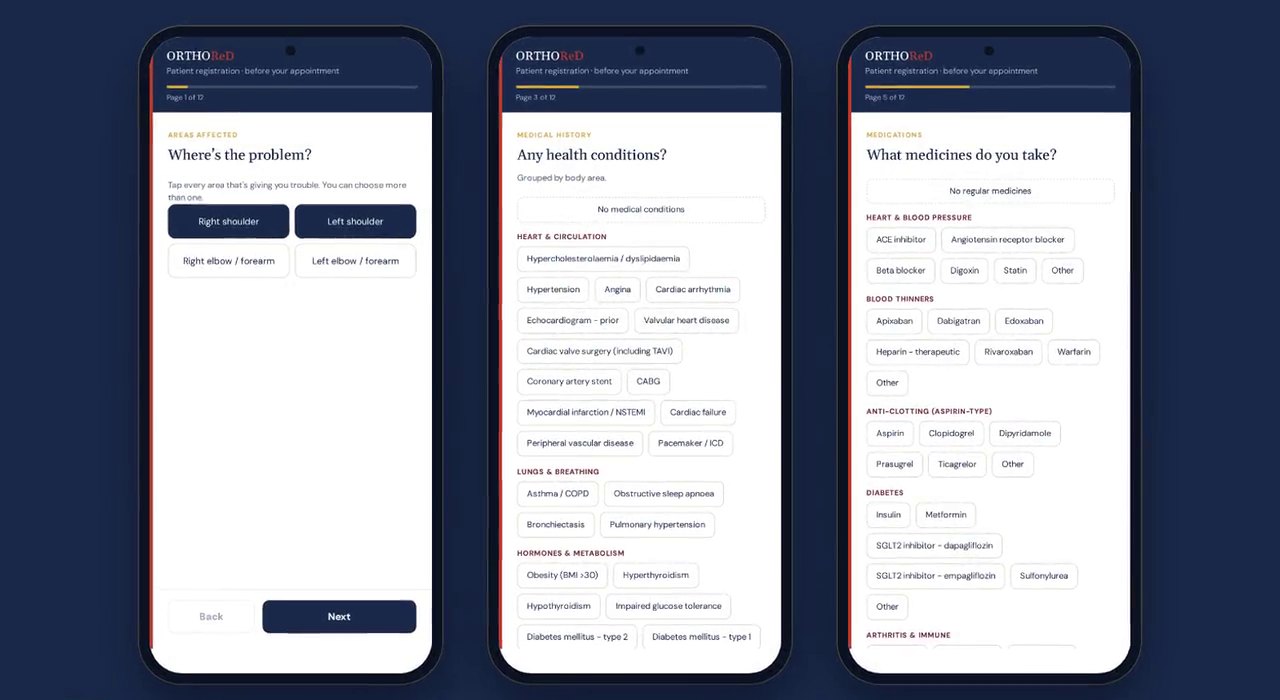
One question, several scores
Every question is asked once and every score that needs it is built from the same answer. Some scores are completed from your clinical record and cost the patient nothing.
A normal joint takes seconds
Each section opens with “my shoulder is completely normal”. Ticking it skips the section and records the best values.
Follow-on questions only when needed
A question appears only when an earlier answer calls for it.
Short
Fifteen to thirty-five questions, depending on the joint and the answers.
Sent at the right times, from your practice
Before surgery, then at 6 weeks, 3 months, 6 months, 12 months and 24 months, with 5 and 10 years if you want them. Each arrives as a link on the patient’s phone, and every patient can be opted out.
Talked through, not posted
Patients do not see their scores online; you go through their progress with them at the visit, so each questionnaire is worth their while.
A common core in every region
Pain; function, strength and movement; overall rating; stability; work and sport; satisfaction, and whether they would have the same treatment again; quality of life. You can add recognised scores but never remove the core, so every surgeon’s data stays comparable.
Recognised scores, as published, and our own
Free established scores are reported as published. Clinician-measured scores have been converted to fully patient-reported versions: the Constant score has been published as the MASSS, and MEPI, the Modified Mayo Wrist and the Harris Hip Score follow the same path. Where the best-known score is licensed, ORTHOReD asks about the same things in its own words and validates against it in research. Every ORTHOReD instrument is published, free for anyone to use.
Alongside the registries
Pre-operative and 6-month timepoints line up with the AOANJRR, NHS PROMs and PHIN programmes, which continue to collect their own scores.
Score-change alerts
A significant fall in a patient’s score alerts you and your staff.
Consent first
No questionnaire is sent without the patient’s agreement. Research use of their answers is a separate consent, opt-in and withdrawable.
Some features are in the first release; others arrive in planned updates.
Software for surgeons.
Not an EMR. Not practice management software.
Ready to go out of the box, with no setup required.